Last month an aerospace company, Reflect Orbital, was given approval by the Federal Communications Commission (FCC) to launch the first of thousands of satellites equipped with 59x59-foot mirrors into space. The goal of these mirrors is to direct precise and adjustable sunlight to Earth on demand.
Reflect Orbital believes sunlight is an underutilized resource. For example, by harnessing sunlight at times it is not typically available, crop yields can be maximized and visibility for remote work sites or emergency responders can increase.

Image credit: Reflect Orbital
The company's plan is to have two satellites in orbit this year, providing light
comparable to a full moon for a few minutes at a time. The goal is to expand this
to over 50,000 satellites with 177-by-177-foot mirrors by 2035, providing daylight-comparable
light for multiple hours.
Reflect Orbital has emphasized that they do not want to put the night sky at risk and recognize the importance of regulation. This service must be requested and approved by local authorities. They intend to ensure that light does not spill out of the defined area it is approved for, and that it can be turned off quickly when desired.
Why is this concerning to both astronomers and environmentalists?
DarkSky International, an organization that fights light pollution, is strongly against the FCC’s recent approval of the satellite launch. Currently, Reflect Orbital has been approved to launch a demonstration satellite, Eärendil-1, into low Earth orbit. Reflect Orbital states that this first satellite will provide a period of data collection in which safety and accuracy can be tested.
The launch of this satellite, the first of a planned constellation of thousands, strongly conflicts with DarkSky International’s guidelines for responsible outdoor lighting. These guidelines call for using light only when needed and at the lowest level necessary. DarkSky argues that directing sunlight onto areas at night will have detrimental effects on nocturnal ecosystems as well as human circadian rhythms. DarkSky International encourages the FCC to require a full environmental risk evaluation to be done by experts.
Reflect Orbital’s plan is especially concerning to astronomers because scattered light from the satellites is expected to increase light pollution. This excess light can be detrimental to astronomers hoping to observe the night sky, making fainter details such as distant stars and galaxies extremely difficult to detect.
Astronomer Miroslav Kocifaj and his team calculated the illumination from these satellites and found that light pollution would extend well beyond the targeted area [1]. Their modeling showed that the beam from a single satellite could brighten the sky up to 14 km (9 miles) from the beam's center to levels exceeding a full moon lit sky.
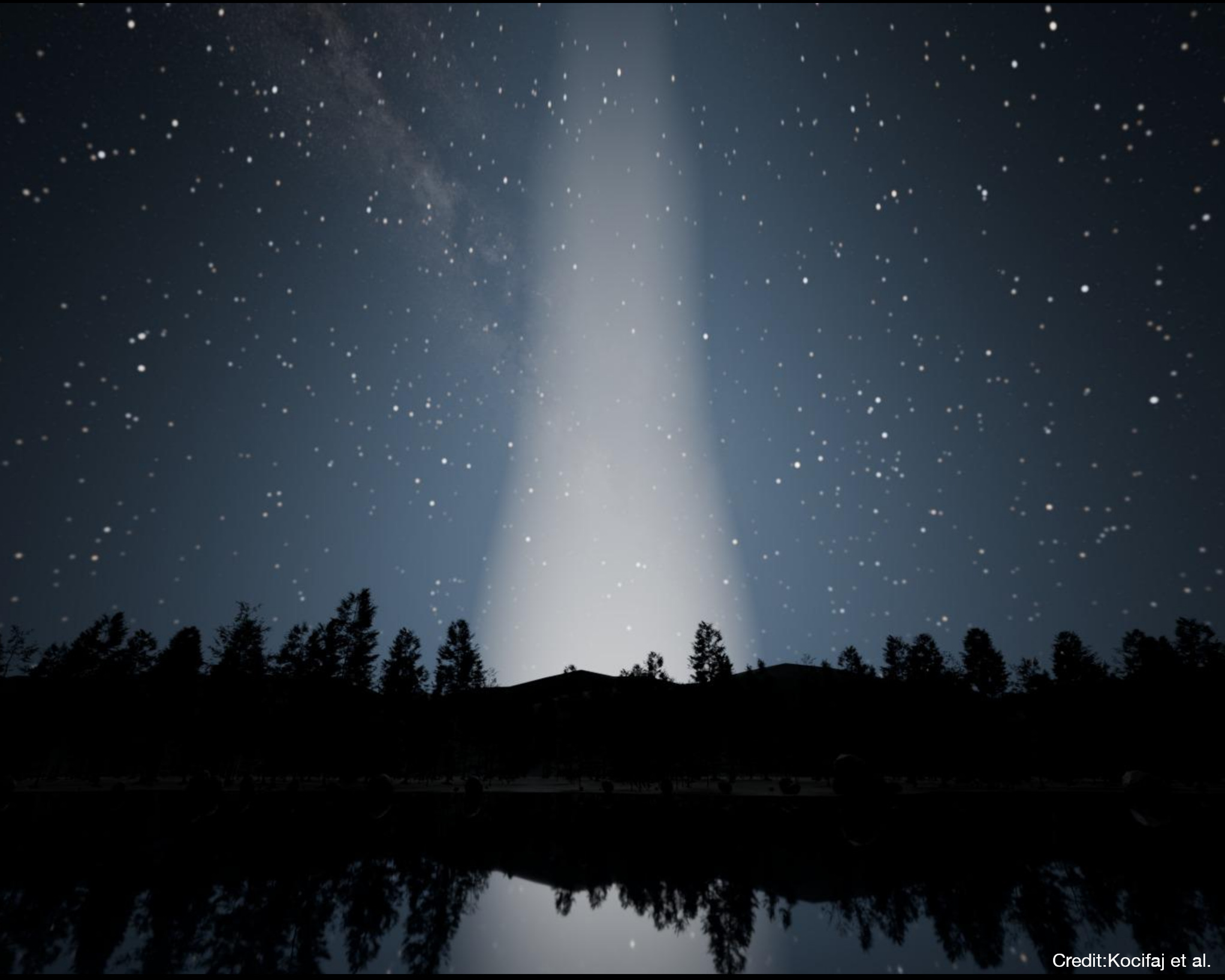
Simulation of the appearance of the night sky 14 km from the center of the beam. Image Credit: Miroslav Kocifaj / Gáspár Bakos / František Kundracik
The American Astronomical Society (AAS) has expressed deep concern regarding
Reflect Orbital’s plan and its approval by the FCC. In a formal statement, the
AAS warned that the light reflected by the satellites could damage sensitive telescope
equipment and temporarily blind pilots or drivers. The AAS also criticized the
FCC’s assertion that the regulation for the reflectors falls outside the FCC's
regulatory authority. If this assertion is true, it suggests that the deployment
of thousands of satellites could occur without constraint.
[1] Kocifaj, M., Bakos, G., & Kundracik, F. 2026, arXiv:2608.06433. doi:10.48550/arXiv.2608.06433